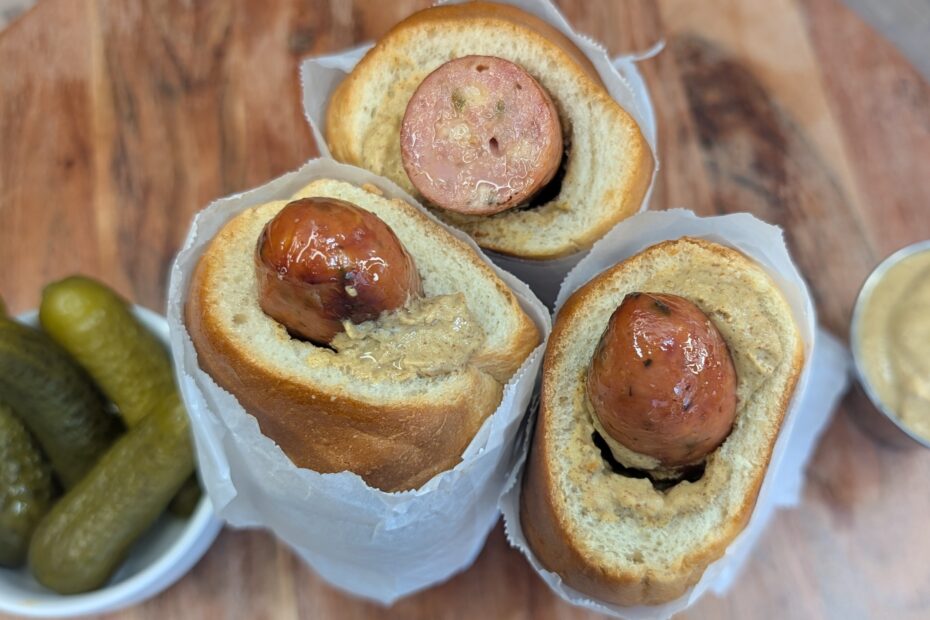
A.K.A. Cheese Sausage in a Roll
(Vienna, Austria; 1970s)
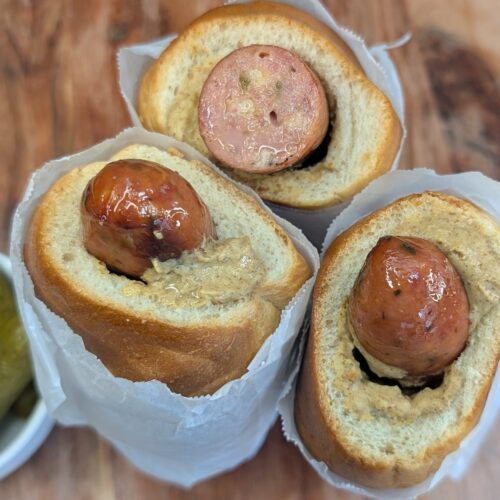
Austrian Käsekrainer
Equipment
- Grill, Griddle or Skillet
- Grill Tongs
- Knife
- Cutting board
- Wooden Spoon Handle (Optional)
Ingredients
- 4 Austrian Käsekrainer Sausages or Any Smoked Cheese Sausage
- 4 Austrian White Sausage Rolls or Bolillo, small French or Hoagie Rolls (roughly the same length as the sausages)
- Austrian Estragon Mustard to Taste or Medium-Hot Mustard
- Prepared Horseradish to Taste (Optional)
Instructions
- Preheat your grill or pan to medium heat.
- Grill the sausages, turning occasionally, until plump and browned, and the cheese begins to bubble from small splits in the casing. Don't worry if some cheese escapes.4 Austrian Käsekrainer Sausages
- For the rolls, slice a small piece off one end and hollow out the center using your knife or the handle of a wooden spoon. Remove only enough bread to comfortably fit the sausage.4 Austrian White Sausage Rolls
- Spread a generous amount of mustard inside each roll.Austrian Estragon Mustard to Taste
- Add (optional) prepared horseradish if desired.Prepared Horseradish to Taste
- Slide the hot grilled sausage into the prepared roll.
- Serve immediately while the sausage is hot and the cheese is still melted.
Notes
Potato Chips
French Fries
Austrian Potato Salad
Cold Lager or Pilsner Notes: Authentic Käsekrainer is a smoked pork sausage filled with cubes of Alpine cheese.
A smoked cheddar sausage is the best substitute if authentic Käsekrainer isn’t available.
Fresh bolillo rolls closely resemble the crusty rolls used at Viennese Würstelstände.
Austrian Estragon mustard has a unique flavor, but Dijon or medium-hot German mustard work very well. I also like to mix 1:1 Dijon and brown mustard. *Food Safety Note:
Always handle and cook animal products safely.
- Cook poultry (chicken, turkey, duck) to 165°F / 74°C.
- Cook ground meats (beef, pork, lamb, veal) to 160°F / 71°C.
- Cook whole cuts of beef, pork, lamb, veal to 145°F / 63°C and allow to rest for 3 minutes.
- Cook fish and shellfish to 145°F / 63°C.
- Eggs should be cooked until yolks and whites are firm, or use pasteurized eggs for recipes calling for raw or lightly cooked eggs.
A Taste of Vienna: Authentic Austrian Käsekrainer
Some of the best meals aren’t served in fancy restaurants. Sometimes they aren’t fancy at all. They don’t need complicated ingredients or elaborate presentation. Sometimes simple, hot, and fast is all it takes to create something unforgettable. Especially when you are with great people.
That was exactly my experience when I recently traveled to Austria for a friend’s wedding.
While touring the heart of Vienna, my buddy talked me into ordering a Käsekrainer from a Würstelstand. I was a bit skeptical at first. I’ll be honest—I had no idea what a Käsekrainer was. I don’t speak German, and the name meant absolutely nothing to me. But my buddy was excited about it, so I figured I’d trust him.
And I tell you… it hit every spot. It was everything great street food should be: cheap, fresh, hot, fast, filling, and absolutely delicious. One bite into the smoky sausage and melted cheese, paired with sharp mustard and a crusty roll, and I completely understood why this has become one of Austria’s favorite comfort foods.
The beauty of Käsekrainer is its simplicity. There aren’t a dozen toppings hiding the flavors. Instead, every ingredient earns its place. The smoky sausage, gooey cheese, crisp bread, and tangy mustard work together perfectly.
If you’ve never been to Vienna, this recipe is about as close as you can get without booking a flight.
The Story Behind Käsekrainer
Although it feels like a centuries-old tradition, Käsekrainer is actually a relatively modern Austrian invention. Most food historians credit Austrian butcher Herbert Schuh and meat processor Franz Thalhammer with creating the sausage around 1971 in Buchkirchen, Upper Austria. Their idea was simple but brilliant: take a lightly smoked pork sausage and fill it with small cubes of Emmentaler, a mild Alpine cheese that softens and partially melts while cooking.
The sausage quickly gained popularity, but it truly became a sensation when Vienna’s famous Würstelstände began grilling it instead of simmering it. The crisp, smoky casing and bubbling cheese turned Käsekrainer into one of the city’s signature foods. By the late 1970s and early 1980s, it had become a staple throughout Vienna and eventually across Austria.
Today, Käsekrainer is considered Austria’s most famous street food. You’ll find it on nearly every Würstelstand menu in Vienna, and for many visitors it’s just as essential to try as Wiener Schnitzel or Sachertorte. Ask a local where to grab a quick bite, and there’s a good chance they’ll point you toward a nearby Würstelstand.
A Würstelstand (pronounced VOOR-stel-shtandt) is a small outdoor sausage stand found throughout Vienna. Think of them as Vienna’s answer to a taco truck. Instead of tacos, they serve sausages—Frankfurters, Bosnas, Currywurst, and, of course, Käsekrainer. These stands have been serving locals for generations and are an important part of Austrian food culture. They’re open throughout the day—and many stay open late into the night—feeding everyone from office workers grabbing lunch to concertgoers, taxi drivers, and night owls looking for a satisfying meal after an evening out.
Many Viennese even have their favorite Würstelstand, and debates over which one serves the best Käsekrainer can be just as spirited as who makes the best Texas barbecue.
Why This Recipe Works
Authentic Austrian Käsekrainer uses cubes of Emmentaler that melt gently without becoming overly gooey. As the sausage grills, the casing becomes crisp while the cheese softens until it begins to bubble out through tiny cracks. Don’t wipe that cheese away. Those crispy bits are one of the best parts.
The sausage is traditionally tucked into a crusty Austrian roll that’s been hollowed out just enough to hold it. This keeps everything contained and makes it easy to eat while walking through the city.
A generous spread of Austrian Estragon mustard adds bright acidity, while prepared horseradish, known locally as Kren, brings a little extra heat if you want it.
Finding authentic Austrian Käsekrainer in the United States can be difficult, but don’t let that stop you. A quality smoked cheddar sausage makes an excellent substitute, especially when paired with a fresh bolillo roll or sub roll.
The biggest difference is the cheese. Austrian Käsekrainer uses mild Alpine cheese cubes (like Emmentaler) that melt gently without becoming overly gooey. American cheddar sausages tend to be a bit smokier and saltier, but they still capture the spirit of the dish.
Serve your Käsekrainer with a dill pickle spear, potato chips, fries, or Austrian potato salad alongside an ice-cold lager or pilsner.
If you ever find yourself in Vienna, do yourself a favor and order your Käsekrainer “mit Senf und Kren”—with mustard and horseradish. Or at least “mit Senf“. It may end up being one of the best meals of your trip.
Congratulations S&D!!
I wrote and edited this post with help from ChatGPT, based on my own tested recipe and original photography.